


SmoothSpine Triple Massager
TRIPLE FUSION TECHNOLOGY"Tablets, injections and months on a waiting list were never going to open a narrowed spinal canal. We built this device to decompress the spine, bathe the starved discs in therapeutic warmth and release the locked muscles around it. All three at once, 15 minutes a day, in your own living room."
Target the three root causes of spinal stenosis pain at the same time: the compressed canal that squeezes your nerves, the dehydrated discs starving for circulation, and the locked muscles holding it all in place. The relief you felt bending forward over the shopping trolley was the warning sign nobody ever translated for you. Gentle dynamic traction creates the space, therapeutic warmth floods the discs with nutrient-rich blood flow, and targeted massage releases the muscles so the relief actually lasts. 15 minutes a day, at home.
Det gick inte att ladda hämtningstillgänglighet


Ideal for
The SmoothSpine Triple Massager was designed for people dealing with:
- A wire of pain that runs from your lower back to your heel the moment you stand up
- Legs that go heavy, dead or pins-and-needles after five or ten minutes of walking
- Instant relief when you bend forward or lean on the shopping trolley, the classic stenosis sign nobody ever explained to you
- Sleeping curled up because it is the only position that opens your canal enough to rest
- Planning every outing around the nearest bench, and skipping the ones without any
- Mornings that start with co-codamol and evenings that end with a wheat bag
- A GP who said "wear and tear", a sheet of exercises, and a physio waiting list measured in months
- A spinal injection that worked for eight weeks and then quietly wore off
- Being told surgery is the only option, with a waiting list of a year or more while your canal keeps narrowing
If you have spent years being told it is just your age, this was built for you.
Full specifications
- Dynamic traction: precision air chambers create gentle, rhythmic decompression, easing the vertebrae apart to take pressure off the narrowed canal
- Therapeutic warmth: a steady, comfortable 50°C sinks deep into the lower back, boosting circulation around starved discs and compressed nerves
- Targeted massage: vibration nodes work along the paraspinal muscles, releasing years of protective tension so your spine holds the decompressed position
- Format: ergonomic lumbar device, mains powered, one-button control panel with built-in 15-minute automatic cycle
- Ritual: lie back on it once a day, 15 minutes, at home. The cycle runs the three phases in sequence: Decompression, Soothing, Reset
- Safety: drug-free, non-invasive, nothing that interacts with your prescriptions. Designed to work alongside your GP's care, not instead of it. Dispatched in batches of 500 units a week
How is this different from what I've already tried?
Everything you have tried so far only ever touched one piece of the problem. Tablets mask the pain but create no space, so the nerves stay trapped. A massage feels lovely and fades by Tuesday, because nothing rehydrates the area or holds the spine open. The gadgets in your drawer vibrated without ever decompressing anything.
Spinal stenosis relief needs three things at the same time: decompression to create space, warmth to flood the starved discs with circulation, and release of the locked muscles holding it all in place. Miss even one and the relief never lasts. The SmoothSpine runs all three, in the right sequence, in one 15-minute cycle.
Your treatments were never wrong. They were just never aimed at all three root causes at once.
They told me it's wear and tear. How can a device help?
"Wear and tear" is a label for something nobody had ten minutes to explain. After 30, your spinal discs slowly lose fluid and flatten. The vertebrae creep closer, the space for your nerves shrinks, and the nerves get squeezed. That is not a mystery, and it is not just your age.
What matters is where you are on the line. Below roughly 60% canal narrowing, there is still room to work: create space, restore circulation, release the guarding muscles, and keep the narrowing from ruling your life. That window is exactly what this device was built for, and it is why acting now beats waiting for a list that is 49 weeks long.
Who should not use this?
We would rather lose a sale than sell to the wrong person. Some back symptoms are true emergencies.
If you ever notice numbness around your groin or saddle area, new problems controlling your bladder or bowels, or sudden severe weakness in both legs, that is not what this page is about. Call 999 or go straight to A&E. Every hour matters.
Is it complicated to use?
No. Lie back on it, press one button, and let the 15-minute cycle run. Once a day, at home, whenever it suits you. Most people use it in the evening in front of the television.
No app, no assembly, nothing to learn. If you can lie down and press a button, you can use this.
Delivery, returns and guarantee
Delivery: orders placed before 2 PM are dispatched the same day, with tracked UK delivery in 1 to 3 working days.
90-day "Pain Free" guarantee: use it every day for ninety days, 15 minutes a day. If you don't wake up one morning and realise you forgot you even had a bad back, send one line by email to info@virelund.shop: "It didn't work." Every penny back, issued within 48 hours. No forms to fight, no questions asked.
Our refund rate is 0.3%: three people per thousand. That's why the guarantee is 90 days, not 30.
Only available at Virelund
The SmoothSpine Triple Massager is sold exclusively on this official site. It is not available on Amazon, eBay or anywhere else.
Look-alike cushions sold elsewhere don't have the dynamic traction chambers, the calibrated therapeutic warmth or the sequenced 15-minute cycle, and they don't carry our 90-day guarantee, which is only valid for orders placed on this page.
No referral, no appointment, no waiting list. Just the device, delivered direct to your door.


The Triple Fusion Technology
To Decompress, Soothe and Release Your Spine

Dynamic Traction: The Decompress
The space your nerves have been screaming for. Precision air chambers gently ease your vertebrae apart, like a clinical traction table, taking pressure off the narrowed spinal canal. Most people feel the first release within minutes.
Therapeutic Warmth: The Soothe
The circulation your starved discs have been missing. A steady, comfortable warmth sinks deep into your lower back, flooding the area around the compressed nerves with nutrient-rich blood flow. Without it, the tissue stays numb, cold and starved.
Targeted Massage: The Release
The step everything else misses. Vibration nodes melt years of protective tension along the muscles guarding your spine, retraining them to hold the decompressed position. Without it, the relief always fades by morning.
Less than one private physiotherapy session.
Private physiotherapy runs £55–£95 a session, and you will be offered two sessions a week for months. A private MRI costs £300–£500 just to confirm what you already know. A caudal epidural costs £450–£2,500 and can wear off within weeks. Decompression surgery costs £5,600–£12,500, with months of recovery and no guarantee you come out walking better than you went in. And none of them gave your spine back its space day after day, because a routine you own at home creates no repeat appointment and keeps you off the treatment treadmill. No waiting list. No referral. No rationing. 15 minutes a day, once, for £69.90.

Fifteen minutes, once a day. That's the whole routine.
Lie back on the floor or the bed, rest your lower back on the device and press one button. In the first five minutes the air chambers inflate and lift, gently opening the space between your vertebrae. In the next five, therapeutic warmth at 50°C soaks into the deep muscles that have been guarding your spine for years. In the last five, the massage nodes release what the warmth has softened. Then it switches itself off. No app, no assembly, nothing to learn, and no one needs to know you use it. Keep it by the bed or under the sofa. If you can lie down, you can use this.
They gave their spine space. Here's what happened.
The SmoothSpine Triple Massager is used by people who spent years being managed instead of treated: co-codamol rationed against the day, gabapentin that fogged the head more than it dulled the leg, a wheat bag, a TENS machine, a drawer full of gadgets. Most of them were told it was wear and tear, and to learn to live with it. Here's what they say about it.


One device against the whole cabinet
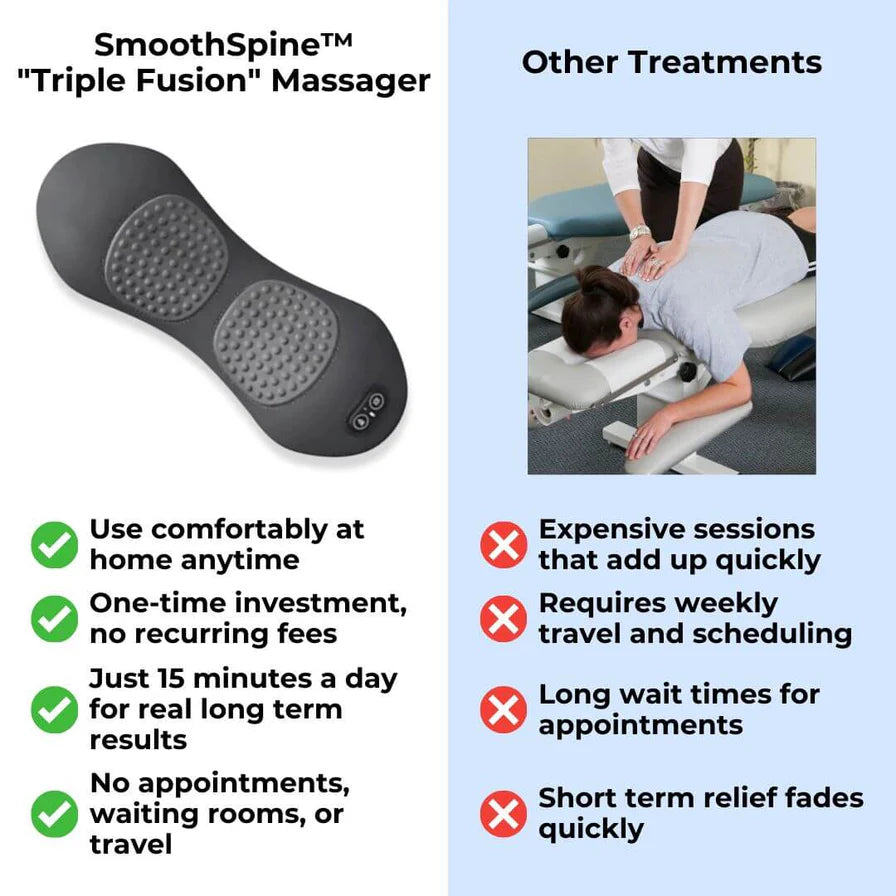
Let's compare the SmoothSpine Triple Massager with what's sitting in your drawer (the wheat bag, the TENS machine, the creams) and with what the private route keeps charging you for.
Triple Massager
Frequently asked questions
Need more answers?How is this different from cheaper back massagers I've seen on Amazon?
Will it actually work for my specific diagnosis?
I'm 64. Isn't this just wear and tear, or just my age?
I've already tried physio, painkillers, and an epidural. Why would this be different?
How long until I'll feel a difference?
How is this different from my TENS machine or a wheat bag?
I'm on co-codamol, gabapentin, or other prescriptions. Can I use it?
I've had spinal surgery, or I'm waiting for an injection. Can I use it?
How often should I use it?
Is it difficult to set up or heavy to move?
What if it doesn't work for me?
I did a lot of research before letting my son order this, mainly because I have a drawer full of things that did not work. A TENS machine, two wheat bags, a lumbar cushion, a massage gun I used twice. I even saw a cheaper lookalike on Amazon and almost fell for it. I was sceptical that anything ordered online would touch stenosis I have had for eight years. Was I ever wrong. By the second week the heaviness in my legs was easing, and last Saturday I did the whole Tesco shop without once hanging off the trolley. It is the first thing from the internet that did what it said. On bad days I add a second session in the evening. I wish I had found it before the second epidural.

The burning down my leg is gone, the nights curled up like a question mark are gone, and I am sleeping flat on my back for the first time in three years. Even my neighbour noticed I'm walking upright again. I'm so much happier!

I'm 69 with stenosis and sciatica that always starts in my lower back and ends in my foot. Gabapentin was the only thing that ever helped a little, but the dose that worked fogged my head so badly I quit it two years ago. This bypasses all of that. I lie on it after dinner, fifteen minutes, done. The relief holds past breakfast, which no tablet ever did. The pins and needles don't wake me up anymore either.

Bought this for my mum, 76, after her GP told her it was wear and tear and to manage it with painkillers from the high-street chemist. She's stubborn and told me not to waste the money. She now calls me to talk about her roses instead of her back. "You're the favourite child now," as she puts it. Simple enough that she uses it on her own every evening, which says a lot.

My husband has had stenosis for six years and the specialist said at his age the best plan was to manage it. That word did not sit well with either of us after 41 years of marriage. Two months in, he walked our granddaughter down the aisle and stayed on his feet until midnight. The rollator isn't in the hallway anymore. The fear mostly isn't either. We should have ordered two.

Two caudal epidurals, each one shorter than the last. My daughter sent me an article explaining the 60% Line and I reckoned this was another internet cure. I kept a log anyway. Day 9 I got out of bed without bracing on the chest of drawers for the first time in years, plain and simple. Co-codamol down from six a day to one. Haven't been back to A&E since October.
